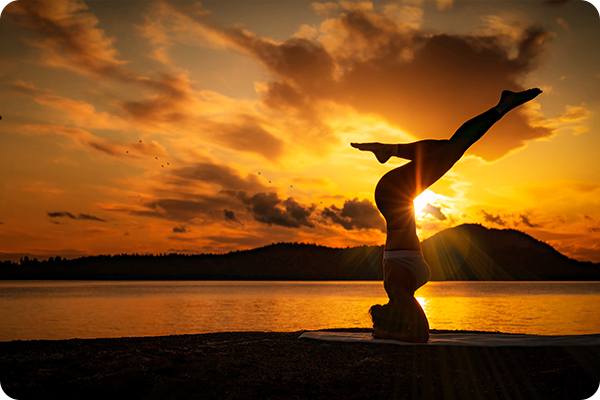
The Golden Mean (aka Golden Section or Golden Ratio) is an ancient and uncanny ratio that has brought us the Parthenon, the pyramids, and the Mona Lisa, and which continues to confound with its inexplicable aesthetic appeal.
Photo by Chris Ganes of Manly, NSW, Australia.Click Photo for a Larger Version
From Da Vinci to Seurat, there's no doubt it's had a significant impact on human creativity for hundreds upon thousands of years, and in this installment we'll discuss how applying the age-old Ratio to your digital photos can transform them into veritable works of art.
A Brief History Of The Golden Mean
The Golden Mean is a ratio that underlies numerous growth patterns throughout nature - from the spiral of a Nautilus shell to the petals of a sunflower, it has an uncanny way of showing up in all manner of things we tend to deem beautiful.
Discovered by the ancient Greeks, and represented by the Greek letter PHI, The Golden Ratio is the irrational number 1.618 , and it's usage dates back to the ancient Egyptians and Greeks who used it in the construction of their temples and pyramids. Artists and architects throughout time have used the Ratio when composing their paintings, buildings, and even photographs, in order to give their creations a sense of natural order and beauty.
The ratio is demonstrated in the Fibonacci series: 1, 1, 2, 3, 5, 8, 13, 21, 34 etc., where each succeeding number after 1 is equal to the sum of the two preceding numbers. The ratio formed -1:1.618- is the Golden Mean - the ratio of BC to AB is the same as AB to AC. If you divide each smaller rectangle again with the same ratio and join their corners you end up with a logarithmic spiral (as illustrated in black below).
A composition following this rule is considered visually harmonious for reasons not yet fully understood. Many believe the Ratio to be hardwired into our DNA.
The Golden Ratio: Golden Spiral
The Golden Mean, The Rule of Thirds, and Digital Photography
Photographers know and use the Rule of Thirds (illustrated in choral colored lines above), but often mistake it as being synonymous with The Golden Mean (illustrated above in black). Although the two are very similar, The Rule of Thirds is a simplified and less exact rendering of The Golden Mean.
The rectangles created by the Golden Mean are of repeating and increasing size, and ultimately provide more fluid guidelines when used to compose an image.
Roughly duplicating the path of the Golden Spiral in your photographs will increase your odds of getting captivating results. As opposed to the static Rule of Thirds, the Golden Spiral forms a fluid line for the eye to trace through the picture.
This style of composition will invite the viewer's gaze into the picture along the line of the spiral, creating a more symmetrical visual flow, and an overall compelling viewing experience.
Start by placing the subject (or focal point) of your photograph in the tightest end of the spiral. The other elements of the picture should roughly follow the path of the spiral, whether that subject is a fence, a beach, a body of water, a mountain range, a row of trees, or even a crowd of people.
While the Golden Spiral is best suited for landscape photography where the lines are long and dramatic, it can also be effective in portrait photography and close-ups (see below).
Remember that the Golden Spiral can be rotated in the frame or transposed from top to bottom to give your pictures more variety in their composition. And don't be afraid to bend - or even break - the rules for the sake of increased creativity and originality.
In the following photograph from subscriber Chris Ganes of Manly, NSW, Australia, the focal point of the spiral has been shifted toward the center, yet the photo retains its symmetry and aesthetic appeal. The viewer is immediately drawn into the cat's eye, and then guided along its muzzle and head, forming a view path that ends at the tip of the paw.
Click Photo for a Larger Version
The focal point is especially strong and well framed, and The Golden spiral has been cropped so you don't see the entire curve - adding to the intensity of the image.
Also, Chris has done a great job of using a repeating pattern: the end of the tail and the cat's leg are parallel and accentuate the impression of movement created by the curve of the spiral.
While the Ratio is not exact, the general form works and can easily be applied to your own digital photos without using difficult mathematical calculations. Once you understand the basic form of The Golden Spiral, it becomes easy to apply intuitively.